

Painting with Diamonds
One month in Lisbon

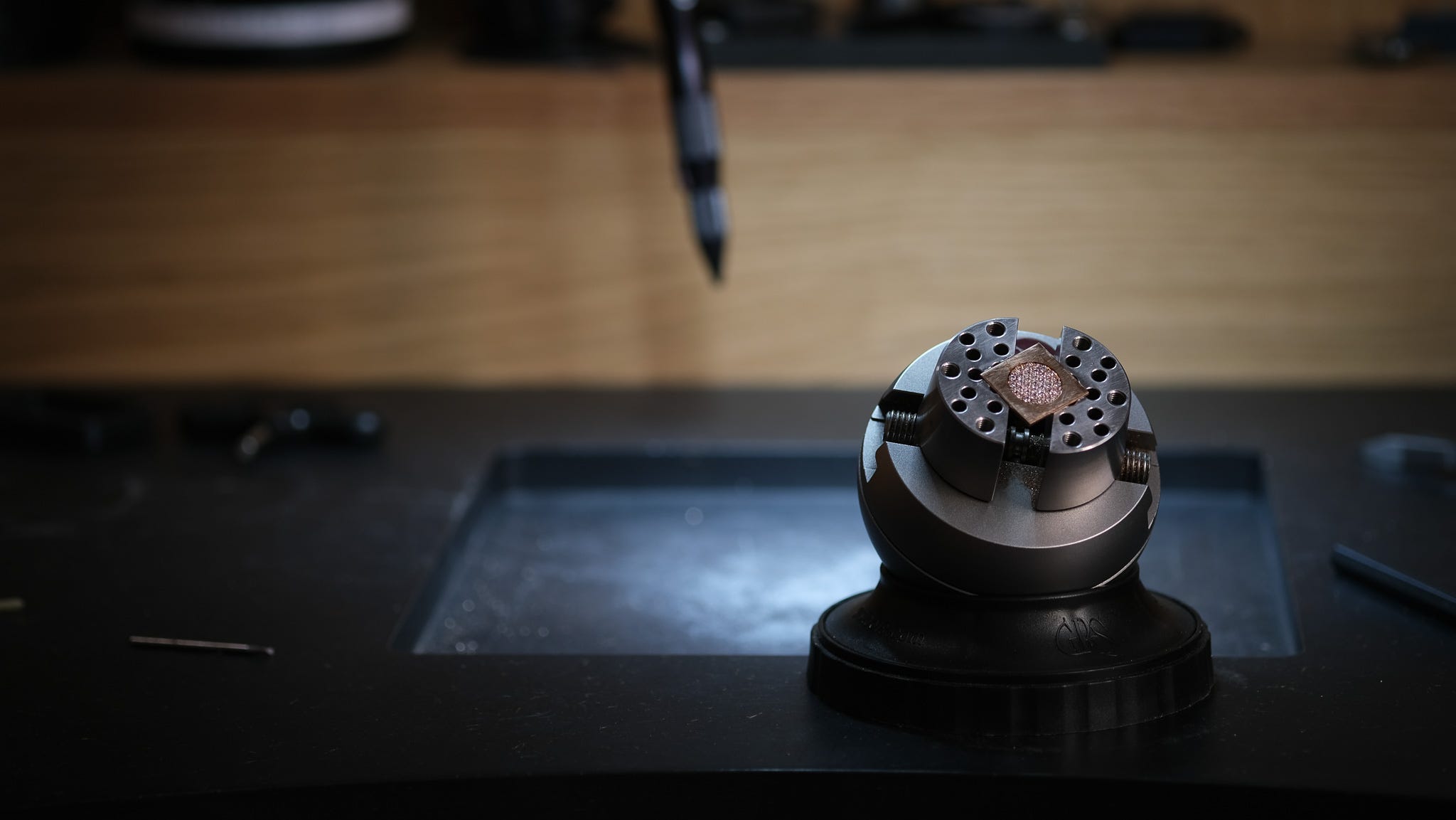
I spent the past month in Lisbon staring through a microscope for ten hours a day.
In fine jewelry, pavé is a science. The word means “paved”; stones set so closely together the metal beneath nearly disappears, the surface becoming something closer to light than material. Each stone is locked in place by tiny beads of gold, cut by hand with a sharpened graver. To give a sense of scale: pavé is often applied to stones between 1mm and 2mm wide. Under the lens, being a tenth of a millimeter off can render a piece unworkable. With every added stone, the room for error shrinks. A single mistake ripples quietly through everything that comes after.
Most jewelry houses, even prestigious ones, outsource stone setting to specialized workshops. There is a clear line between the person who designs and the person who sets - between the vision and the hands that realize it.
I went to Lisbon to blur that line. I want to own the entire process, from the first forming of the metal to the final seat of the stone. Not because it’s efficient (it isn’t, not even close!), but because there is something about stone setting that I didn’t expect: the total absorption of it. Under the microscope, with a graver in hand and a stone that needs to be exactly right, everything else disappears. It is one of the few things I’ve found that asks for your complete attention and rewards it completely.
The two instructors at GRS are among the best stone setters in the world, not as a figure of speech. One of them, Jonas, likes to say: “Nothing is too small. You just have to zoom in more.” It sounds simple until you’ve spent a week trying to prove it. Under the microscope, the work either holds or it doesn’t.
That standard is what I’m bringing back with me to my studio in Japan. I’m excited by the challenge and to keep developing this discipline for years to come.
The real work begins.


